
Powering the Next Phase of Growth: What SIEW 2026 Means for Singapore and ASEAN
Xi’s ‘Great Power’ Trilateral and the Peak of Diplomatic Symbolism
November 2026
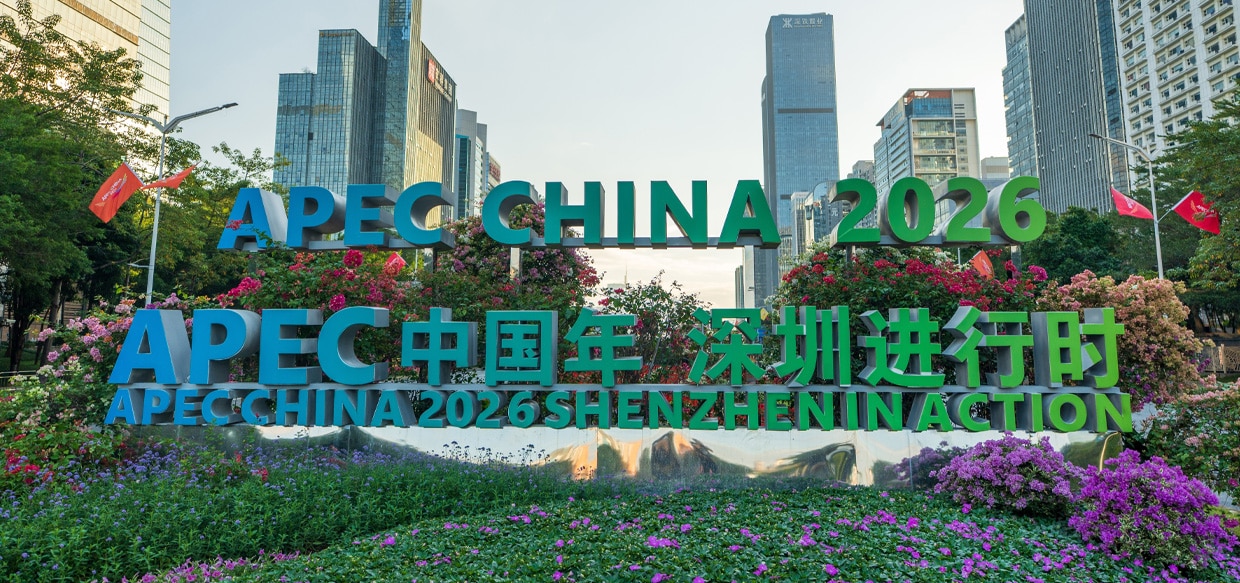
The international news cycle had a short reprieve from the Nvidia saga last week, as much of the world’s media focused on Shenzhen, China’s booming southern tech capital. Following the high pageantry of President Xi Jinping’s state visit to Washington in September, the 2026 APEC Economic Leaders’ Meeting set the scene for a worthy sequel, with an additional twist – a first-of-its-kind trilateral summit between the leaders of China, Russia and the US.
In any other year, APEC’s diplomatic ‘speed dating’ would have been enough to guarantee global headlines. Anywhere up to 19 heads of state and government typically attend, with dozens of bilateral meetings taking place on the sidelines. This year, however, the trilateral became the defining story of APEC, even if the symbolism of the occasion was ultimately more significant than the substance of the talks.
The notional image of the world’s three most influential leaders sitting down to decide the great questions of war and peace inspired innumerable allusions to Yalta, the fateful 1945 conference between Roosevelt, Churchill and Stalin that reshaped the post-War international order. But unlike that weeklong marathon of negotiations, the Shenzhen trilateral was a carefully choreographed 90-minute affair. Excellent photo ops, pre-prepared statements, and ultimately a short ‘Declaration toward Peace’, featuring four safe and seemingly unconnected themes:
- Reforming the United Nations;
- Increasing refined petroleum supplies;
- Protecting the immunity of state officials from international courts;
- And addressing nuclear risk reduction and non-proliferation.
Yet as often with high-stakes diplomacy, symbolism can have a substance of its own – and there was no shortage of it.
Getting the optics right
Returning the favour from September, Xi Jinping broke with convention to meet Donald Trump at the airport, while the US president, for his part, referred to Vladimir Putin as “my friend”, much to the dismay of foreign policy circles in Washington. The sight of the Russian leader ‘back from the cold’ would have ruffled feathers across European capitals, which had done almost everything possible to isolate Russia economically and diplomatically since 2022. Then there was the image of the Chinese president on the podium, flanked on each side by Trump and Putin, in an implicit signalling of China’s place at the centre of world affairs – and a tacit recognition of America’s relative decline.
The optics confirmed what many had predicted for years: the gradual recalibration of the global order towards a more balanced, multipolar composition. But while the symbolism spoke volumes, this was not some ‘grand bargain’ to carve up the world into spheres of influence. Historical parallels with 1945 are rhetorically powerful, but hardly illustrative. This was not Yalta 2.0, nor was it meant to be.
Even the oft-maximalist Kremlin position, reliably echoed in Russian state media for weeks beforehand, was that Russia supports multipolarity and explicitly rejects the Yalta analogy. And despite President Trump’s well-known disdain for multilateral institutions and somewhat cavalier attitude towards traditional allies, there is little doubt that he views the world through the prism of American primacy.
“Gather in Shenzhen, witness the wonders”
For Xi Jinping, the goal was to show middle powers and the Global South that China is a responsible stakeholder in the international system: a global power that – unlike Russia and the US – is at peace, is stable, and prizes sovereignty above all else. His message called for deeper economic integration, resisting protectionism, and enhancing cooperation on innovation and development.
This was the third time APEC had been held in China, with Shenzhen joining Shanghai (2001) and Beijing (2014). President Xi reportedly selected the city himself, harking back to its significance as a trailblazer for China’s Reform and Opening.
The choice of Shenzhen was intended to convey China’s undisputed arrival on the global stage as an innovative, prosperous, future-oriented superpower – a message that’s especially pertinent this year, as China embarks on its latest Five-Year Plan and looks ahead to the all-important 21st Party Congress next autumn.
Who benefits?
Trump and Putin, of course, both had their own reasons for coming to Shenzhen, even if some of the topics they would have wanted to address – Ukraine, Iran, AI, rare earths – were hardly given any airtime.
For President Trump, the summit came hot on the heels of disastrous midterm elections – a stunning rebuke of the Iran war, coupled with a creeping public distaste at the perceived corruption among the president’s inner circle.
President Putin, meanwhile, has had his own issues to deal with, as Ukraine continues to hit deep into Russian territory. Last week’s strike on the symbolic Kerch Bridge – timed for the very day Putin was due to depart for Shenzhen – was intended to send an audacious message to the Russian leader ahead of the trilateral.
Nonetheless, there is no doubt that Putin had more to gain from the diplomatic spectacle than Trump. His message – both at the APEC CEO Summit and the Economic Leaders’ Meeting – was one of defiance in the face of sanctions, tempered by openness to the Global South; in short, Russia is not isolated, it’s back at the centre of global events, and it’s reorienting towards the Asia Pacific. His main goal was threefold: keep Trump onside, keep Xi onside, and ensure that Russia retains a central role in any reshaping of the global order. The few substantive takeaways from the trilateral, as identified in the Declaration, echo this point.
Decoding the substance
The nuclear conversation is one in which Russia undoubtedly belongs at the top table, as the custodian of the world’s largest nuclear arsenal. Since the New START treaty expired this year, neither Moscow nor Washington has had any binding limitations on their strategic forces. At the same time, the US has repeatedly tried to pressure Beijing to restrain its nuclear expansion, with no success – and this was an agenda item Trump was reportedly keen to address in Shenzhen. China, meanwhile, has quietly opposed Russia’s nuclear sabre-rattling over Ukraine. By affirming the maxim that “a nuclear war cannot be won and must never be fought”, all sides are signalling their buy-in on a topic that, framed from different perspectives, can be construed as a symbolic win for all three.
Ditto with UN reform. Permanent membership of the UN Security Council is another essential identifier of great power status in the post-War order that all three countries share, and it chimes with one of President Xi’s messages from the trilateral – that of a shared legacy of victory in the Second World War. It’s unclear what reform would mean, however; neither of them is ever likely to forfeit their right of veto, even though that’s often the main barrier to achieving consensus at the UN.
The question of ICC jurisdiction seemed an odd addition, clearly designed with Putin in mind. The Russian leader has skipped all other APEC and G20 summits since the start of the Ukraine war, and there’s been an ICC arrest warrant against him since 2023. Trump has invited him to the upcoming G20 Summit in Miami, and this feature of the Declaration has prompted speculation over whether he might actually attend.
Perhaps the most actionable part of the Declaration was the commitment to increase supplies of refined petroleum, which speaks to President Trump’s current preoccupation with energy costs in the wake of the Iran war, and comes on the back of the October diesel deal with Russia. It could also be read as a way of pressuring President Volodymyr Zelensky to rein in Ukrainian strikes against Russian energy infrastructure, which have disrupted over half of Russia’s petroleum refining capacity and caused throughput to fall to a 20-year low.
What lies ahead
It’s become almost a truism that opposition to China is one of the few truly bipartisan issues in American politics, and the recent Nvidia scandal has redoubled attention on technological competition and national security, even forcing the administration to take tougher measures. The latest example of this was the BIS rule on restricting China’s remote access to advanced American AI chips and computing infrastructure, which took effect on 19 November – the same day the three leaders sat down in Shenzhen. Adding to the noise, Huawei has just been found guilty of multiple US criminal charges, including conspiracy to steal trade secrets.
Within the US administration, the president’s amenable stance toward China is not shared by some of his closest cabinet members. Treasury Secretary Scott Bessent has been increasingly vocal about China’s apparent lack of commitment on the Busan agreement and its slow implementation of rare earth licensing. Meanwhile, new reporting suggests the USTR is set to announce another tariff hike on China under Section 301 as soon as this week.
With the new Democratic intake poised to take their congressional seats in January, Trump is entering the ‘lame duck’ period of his presidency – and with it, the prospect of legislative gridlock at home. This means he’s likely to become an even more dominant force on the international scene, where he has substantially more latitude to shape the agenda without having to worry about the view from Capitol Hill.
But Trump’s executive authority comes with an expiry date. Just as Vladimir Putin should understand that the window for influencing US policy towards Russia may well close with the twilight of Donald Trump’s presidency, so Xi Jinping must surely know that he may soon have to deal with an America that is less inclined to engage with China transactionally, as a strategic equal.
While the trilateral may ultimately have been light on detail, with some of the more substantive issues on trade and AI apparently kicked down the road to next month’s G20 in Miami, the space for such direct leader-level engagement may soon get narrower. In this context, the importance of a good personal and working dynamic between the leaders of all three powers should not be underestimated.
-

A World Recalibrating: Strategic US Absenteeism is Accelerating ASEAN’s Regional Integration
-
New research from Sandpiper reveals business leaders blame the US more than China for trade war, believe US should make first moves to de-escalate
-

Beyond Traditional Platforms: How Asian Businesses Are Breaking Through Digital Marketing Fatigue